    Two thousand years have bent my back,
A million miles of dust lie at my feet:

        I wander, I grow old.

With wrinkled fingers, the wind pulls icy cold,
    Touches through my sandals, worn and thin,
    Their soles in fragments fall and track
Across the world, crossing till at last they meet
        Before thy walls, my home, Jerusalem.
    From whence my lonely wanderings begin.

My friends are dead,
    And yet my thoughts return to them,
    And to another who had died
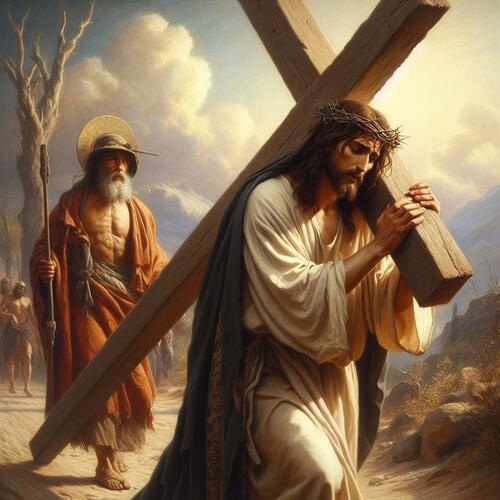
A painful death upon a lonely cross,
Iron nails through his hands, which shed
    Their sacrifice of blood, a loss
	Which no one did appreciate, and nor did I,
I, who as he passed me on the hill
    Did urge him on: “Go faster.”
    And sent him to the Skull to die.

One word only he said, “Abide.”,
        Before he went his way.
I cared not then, perhaps I care not still,
But when he died, the earth shook, and so I knew
    And acknowledged him my master.

Then, perhaps. But if I am forthcoming,
    It is my age which gives this view.
I still abide, although across the world I stray.

        I wander, I grow old.

    My name is Ahasuerus:
I would be glad of a second coming.

                                  1974
Notes:
My first encounter with the legend of the Wandering Jew came in a sort story in a 1964 collection (The Terminal beach) by English author J.G. Ballard. The story is called "The Lost Leonardo" and tells the story about the theft of Leonardo's painting The Crucifixion from the Louvre. In the story, the character is named Ahasuerus, and he stole the painting to "touch up" his own face in the picture, to show regret. Although I had read the story several years prior to writing the poem, the image of a man wandering the earth, 2000 years old and weary but his body unchanged, had stuck with me and still does.
The legend originally appeared in the 13th century, but it has roots back in some quotes from the Gospels of both Matthew and John.
There were many names for this character. Ahasuerus dates from the 17th century, and is an adaption of the Persian king Xerxes. I only found out more about the legend with the coming of the internet. I've put a link below. I still prefer this name in the poem to the alternatives.
I'm sure I must have edited this poem before I settled on this version in 1974, but I have no records. I know it came very quickly and easily, so I suspect that all I did was fiddle a little with the lines and the rhythm. There is a rhyme for each line in the poem, but it occurs at irregular intervals. The rhythm is there as well, but equally irregular.
 Empty Chairs
You must be logged in to post a comment.